
The library
Twenty-one documents. Take all of them.
The whole method, written down and published in Spanish — free, ungated, and yours before any partnership, any paperwork or any conversation with us. Print it, copy it, put your home’s name on it.
How it fits together
One ladder. One set of domains. One owner per rule.
A children’s home does not need six methods. It needs one, written down well enough that a new caregiver can follow it on their first shift and a director can audit it on a Tuesday. Three rules hold this library together, and they are worth knowing before you download anything.
-
1
One capability ladder, six rungs. I do it · We do it together · You do it with support · You do it · You solve it · You teach it. Nothing is marked as learned before rung four, and nothing counts as readiness to leave before rung five — because rung five is the month the budget doesn’t reach. There is no rung zero: not yet observed is an instruction to the adult, never a verdict on the child.
-
2
One set of domains. Twelve capability domains from two to eighteen, opening into fifteen transition domains at fifteen. Most documents here are simply the detail of one domain — regulation, work, food, money, English — which is why they never contradict each other about what they are measuring.
-
3
One owner per rule. The suicide script lives in What Do I Say? and nowhere else. The country reporting routes live in the Child Protection Manual. The child-labor standard lives in Work with Purpose. Everything else points at them rather than writing a second version that will eventually drift out of step.
If you only take three
Start with the one a new caregiver can use tonight.
1. What Do I Say? — forty-eight things a child actually says, and what to say back. No training required to be useful with it on a first shift.
2. Child Protection Manual — and specifically section 27, the per-site directory. A home can have the entire manual unimplemented and still be meaningfully safer the day that one page is filled in and the numbers verified.
3. 100 Experiences That Build Capability — because it answers the question a house asks every single day, which is not what is our theory of change but what do we do this afternoon.
Every document carries the same authorship note and the same standing notice: pending review by a licensed clinician in Mexico and Colombia. Training material, not clinical protocol. Your local child-protection rules always take precedence.
For the team, not the file
A staff training manual, and someone to run it
The deepest thing we give away, and the one the other twenty are built on top of. It changes what happens in a hallway — which is where most of a childhood in residential care actually takes place.
Growing with Purpose · Spanish · 77 pages · Crecer con Propósito
Growing on purpose
A full training manual on child development, grief, trauma and everyday accompaniment, written for the people who actually live alongside these children: caregivers, educators, directors, volunteers and support staff.
It is built on one premise — a person becomes capable when stability, structure and direction are present at the same time — and on one uncomfortable distinction: a home can be operationally excellent and still be developmentally insufficient. Food, clothes, school, cleanliness and a timetable are indispensable. On their own they do not produce trust, regulation, competence, identity or readiness to live outside.
Twenty worked cases from age three to seventeen, each with the developmental lens, what to do, and the words to say. Three cards to print and carry. A quarterly review, a routine audit, and a fourteen-point institutional checklist.
The nine modules
- Care is not development — audit one of your own routines
- Development by age — what should be emerging, and when
- Relationship, regulation, executive function — co-regulation role-play
- Grief, loss and separation — language and cases
- Trauma and safety — crisis, and rehearsing a disclosure out loud
- Guidance and discipline — consequences that repair
- Adolescence and transition — the capability ladder
- Staff wellbeing and limits — building a supervision plan
- Integration — full cases and an institutional plan
What we are actually offering
The manual is free and always will be. Download it, print it, copy it, put your home’s name on it.
What a document cannot do is run the nine modules with your team, watch real interactions, and come back next quarter.
That part we do ourselves, at no cost to the home. Roughly sixteen hours, in Spanish, in your building.
Where it comes from, and what it is not. The author is Scott Kimball, PhD. His training runs through all three disciplines the manual needs: a bachelor’s in psychology with child development studied in depth, a master’s in clinical psychology, and a doctorate in industrial and organizational psychology — which is where the premise of structure, stability and direction comes from. The manual sets this out on its own fourth page. It is training material, not clinical treatment, and it has not yet been reviewed by a licensed clinician in Mexico or Colombia — that review is being arranged, because a local reviewer brings what no foreign training can: their country’s protection system, the real referral routes, and a current license where the work actually happens. Your local child-protection rules always take precedence.
The rest of it, also free
Eighteen more documents, and they fit together
These sit alongside the training manual and are referenced by it. They share one capability ladder and one set of domains, so a director is not holding six different systems. Like everything else here: free, ungated, and yours to print, copy and adapt with your home’s name on it.
Spanish · 24 pages · Matriz de desarrollo 2 a 18
Development Matrix Ages 2 to 18
Twelve capability domains — self-care, home, food, time, learning, money, relationships, regulation, decisions, community, work, identity — and what each one looks like at 2–3, 3–5, 6–8, 9–12, 13–15 and 16–18.
It runs on the six-rung ladder: I do it, we do it together, you do it with support, you do it, you solve it, you teach it. Nothing counts as learned before rung four, and nothing counts as ready to leave before rung five.
Ends with a per-child transfer plan, a twelve-question audit for supervisors, and a 16–18 readiness checklist that is marked by demonstration rather than conversation.
Download · PDFSpanish · 41 pages · Kit de duelo y pérdida
Grief and Loss Kit
The loss a children’s home sees most often has no funeral and no date: a parent who appears and disappears, a visit that was canceled, a reunification that never quite happens. This covers that, and it covers death.
How grief actually shows up, how understanding of death changes with age, what to say and what not to, three activities to do with a child, the family-visit protocol, and when to refer.
Plus the section nobody wants to write: what a home does when the person who died belongs to it — a child or a member of staff.
Download · PDFSpanish · 30 pages · ¿Qué digo? Conversaciones difíciles
What Do I Say? Difficult conversations
Forty-eight things a child actually says, from “nobody loves me” to “are you going to adopt me?” to “I want to die.” Each one gets what you can say, what to avoid saying, what to do in the moment, and when to stop handling it alone.
Indexed in eight groups, because nobody reads a document like this end to end at the moment they need it.
It is the most immediately usable thing we give away. A new caregiver can be useful with it on their first shift.
Download · PDFSpanish · 13 pages · Staff · Plan Individual de Desarrollo
Individual Development Plan
One plan per child, two to four goals, reviewed every ninety days against the twelve capability domains. Strengths first, the child’s own voice on the page, and goals written so that two adults watching the same Tuesday would say the same thing.
It replaces the one-page form in the matrix, which now points here.
Download · PDFSpanish · 18 pages · Staff · Manual de transición 15–18
Transition Manual 15–18
The last three years, year by year. Fifteen transition domains, real-practice tests, the network of five, the final ninety days week by week, the first week out, and follow-up at 30, 60, 90 and 180 days.
Housing is in it, which it was not before — and a young person without documents, confirmed housing or a plan B is not ready, whatever the other fourteen say.
Download · PDFSpanish · 21 pages · The young person · Mi vida. Mis habilidades. Mi futuro.
My Life. My Skills. My Future.
The same fifteen domains, in the young person’s own hands and own language. Roughly eighty concrete skills, each rated on the six rungs, with a column for evidence — when you actually did it, not when it was explained to you.
Ends where it should: nobody is at rung six in fifteen areas at eighteen. Nobody.
Download · PDFSpanish · 26 pages · Staff · Conectar y crecer
Connect and Grow
Thirty-five short activities for the one thing that cannot be taught by saying “be nice”: connecting, listening, asking for what you need, saying no, accepting a no, repairing, and belonging without giving up your own safety.
Each has an age, an objective, the materials, what the adult actually says, and where it gets used in real life that same day. Plus a twelve-week program.
Its most important page is the one that says a social skill does not fix an unsafe environment — if a child is being harmed, the institution protects, it does not train the child to cope better.
Download · PDFSpanish · 19 pages · Ages 6–18 · Dinero con propósito
Money with Purpose
Financial capability as a progression of real decisions, not a subject. Eleven modules from “spending is choosing” at six to a full simulated month on your own at seventeen — run six to twelve months before leaving, not in the last one.
Rung four is making a budget and keeping it in a normal month. Rung five is the month something breaks. The second one is what predicts.
Download · PDFSpanish · 23 pages · Ages 13–18 · Trabajo con propósito
Work with Purpose
Twenty-four modules from “what can I contribute” at thirteen to holding a real job at eighteen, built on twelve employability capacities — reliability, communication, initiative, learning, teamwork, problem-solving, self-management, professionalism, service, safety, self-advocacy, growth.
Child-labor law and safeguarding are on page three, not in an appendix. An eight-item check before any placement, the three things that get confused constantly — a chore, a formative experience, a job — and the rule that an opportunity requiring you to skip one of those checks is not an opportunity.
Ends with an experience passport, a supervisor evaluation and a ninety-day plan. Attending the punctuality course is not evidence. Arriving eleven times out of twelve, ten minutes early, is.
Download · PDFSpanish · 20 pages · Mentors · Guía de mentores
Mentor Guide
The mentor is one of the five in the network of five, and the commitment we ask for is three years, paid — because a mentor who leaves after four months teaches the lesson we are trying to undo.
Ten principles, then the limits in detail: gifts and money, transport, messaging and social media, family and history, confidentiality and what to do with a disclosure, self-harm, supervision, and how a mentorship is closed well rather than allowed to fade.
The photography rule is ours and it has no exceptions: a mentor does not photograph or publish the young person — not the face, not the name, not the story, not with permission, not on a private account. A young person’s life is not content for an adult’s feed.
Download · PDFSpanish · 39 pages · Everyone · Manual de protección infantil
Child Protection Manual
The whole safeguarding frame: code of conduct, prohibited behaviors, safe recruitment, the visibility rule, physical affection, bedrooms and bathrooms, transport, visitors, gifts, digital contact, peer harm, and the eight steps after a concern.
It carries the reporting routes for Mexico and Colombia — 911 and the Procuraduría de Protección de NNA under the Sistema Nacional DIF; ICBF Línea 141, free and 24-hour, with Defensoría, Comisaría and Centro Zonal — plus a per-site directory to fill in before you need it.
The photography rule is ours and it is stricter than the sector’s: we do not publish images of the children we serve, and that is not a consent question. A permission form signed by an adult is not a decision made by the twenty-five-year-old who has to live with the picture.
Download · PDFSpanish · 37 pages · Ages 2–18 · Kit de regulación emocional
Emotional Regulation Kit
Twenty-three practices, from blowing out an imaginary candle at three to writing the message you don’t send at sixteen. Each one has an age, an objective, the steps, what the adult actually says, and where it gets used that same day.
Built on a six-step sequence — notice, name, regulate, choose, repair, learn — and an arousal scale of 0 to 5 that belongs to the child. Intervening at 3 is far easier than starting at 5, and nearly all the useful work happens there.
Ends with the limits: when to escalate, and the page that says plainly this kit does not assess risk. The suicide script lives in What Do I Say?, and this points there rather than writing a second one.
Download · PDFSpanish · 39 pages · Staff & directors · Cuidar sin perdernos
Caring Without Losing Ourselves
Caregiver wellbeing treated as infrastructure rather than a perk. Load, relief without shame, emotional limits, not rescuing, the caregiver’s own grief, debriefing, supervision that helps, and the staffing decisions that make all of it possible.
We cannot ask children for constant regulation inside a system that continuously dysregulates the adults. Three levels of responsibility — person, team, organization — and a warning against turning a system problem into a caregiver’s moral failing.
Its sharpest page is the one on staffing: a roster that only works when nobody gets sick, nobody takes leave and no crisis happens is not a roster. It is a bet.
Download · PDFSpanish · 41 pages · Case teams · Volver a conectar
Reconnecting with family
Reunification and family visits. An eight-stage reconnection sequence from a letter to a supervised overnight, the visit plan, what to watch during a visit, what to do when a relative doesn’t turn up, and readiness criteria for the child and the family separately.
It refuses the two opposite errors. Poverty is not neglect — lack of resources alone should not keep a family apart. And a good visit proves nothing: two hours in a park on a Saturday and an ordinary Tuesday at six are very different tests.
Follow-up at 72 hours, 30, 90, 180 and 365 days, because what is being tested here is not a person but a whole household. Plus the page nobody plans for: when reunification stops being safe, and the grief of a second separation.
Download · PDFSpanish · 39 pages · Ages 2–18 · Crecer bien
Growing Well
Nutrition as a progression rather than a menu. What a two-year-old practices at the table, and what a seventeen-year-old has to be able to do alone: plan a week, buy it, cook it, store it, and solve it when the budget doesn’t reach.
The adult decides what, when and where food is offered. The child learns how much. Confusing those two roles is where nearly every mealtime battle starts. No forced plates, no dessert as payment for vegetables, no food withdrawn as punishment.
It refuses to give calorie targets or weight goals, and it says why. The WHO fruit-and-vegetable figures are included with WHO’s own caveat — conditional, extrapolated from adult evidence — because they are useful for planning a menu and harmful as a quota enforced at a table.
Download · PDFSpanish · 41 pages · Ages 2–18 · Inglés para mi futuro
English for My Future
English turned into twenty minutes a day rather than a subject. Listen, speak, read, write — and use, which is the one that decides whether the other four were worth anything. Every routine ends with a mission for the rest of the day.
Then the modules a young person actually needs: the airport, the interview, the supervisor, the bank, the doctor. “I don’t feel safe doing that without training” is on the work page, because a phrase like that is protection, not vocabulary.
We teach English to add a tool, not to replace Spanish. Punishing a child by forbidding their own language appears on the list of things we never do — a child taught that their language is a problem learns English more slowly, not faster.
Download · PDFSpanish · 33 pages · Ages 2–18 · 100 experiencias que desarrollan
100 Experiences That Build Capability
A hundred activities, ten to a page, each with an age, a duration, the materials, what the child actually does, and where it shows up in real life that same day. From getting dressed at two to a full rehearsal of independence at seventeen.
It exists to answer one question fast: I have thirty minutes and I want to build cooperation. So it carries a complete index of all hundred — number, title, age, time, capability — plus ways in by group size and by what you’re actually seeing in the house this week.
The page that matters most is the one saying what this isn’t: if you can’t name the capability and where it transfers, it’s entertainment. Which has real value — children need play and rest for their own sake — but calling it development hides what’s missing.
Download · PDFAll of them carry the same authorship note as the manual, and all are pending review by a licensed clinician in Mexico and Colombia. Training material, not clinical protocol. Your local child-protection rules always take precedence.
For the young person, not the home
My Path, My Future — a life board in three parts
Twenty pages a young person fills in themselves, three times over: today, in six months, and in a year. It is built on the three things a person needs at the same time in order to become capable — stability, structure and direction — and it is the only thing we make that nobody else is allowed to read.
- OneStability — what holds me up Opens with the four questions a child is always asking and almost never says out loud: do I feel safe, do I feel loved, do I have potential, am I succeeding at something. Answered on a scale, privately, three times a year apart.
- TwoStructure — what I do each week A children’s home is already one of the most structured places a person can live. This part is not about that structure. It is about the hours that are actually theirs, and what gets built in them — what they already know how to do, and what they are practicing now.
- ThreeDirection — where I am going Not what do you want to be. What do you want to bring to the world? A job title has to be waited for; a contribution can start this week. Then a full blank page to draw and paste on — the board itself.
Spanish · 20 pages · US Letter · Mi camino, mi futuro
It is in Spanish because it is for the children, not for us. Prints in black and white on ordinary paper. No sign-up, no email box, no way for us to know who filled one in.
Directors: print a set and hand them out. Nothing in it needs a facilitator, a session, or a returned copy.
Download · PDFFree to print, copy and adapt. An English edition is being set now.

Printables
And the things that go on a wall
Not everything useful is a manual. These are the one-page formats — posters for the kitchen, a weekly menu, a growth record, a leaving-care document checklist — designed to be printed once and looked at every day, by people who will never read a thirty-page PDF and should not have to.
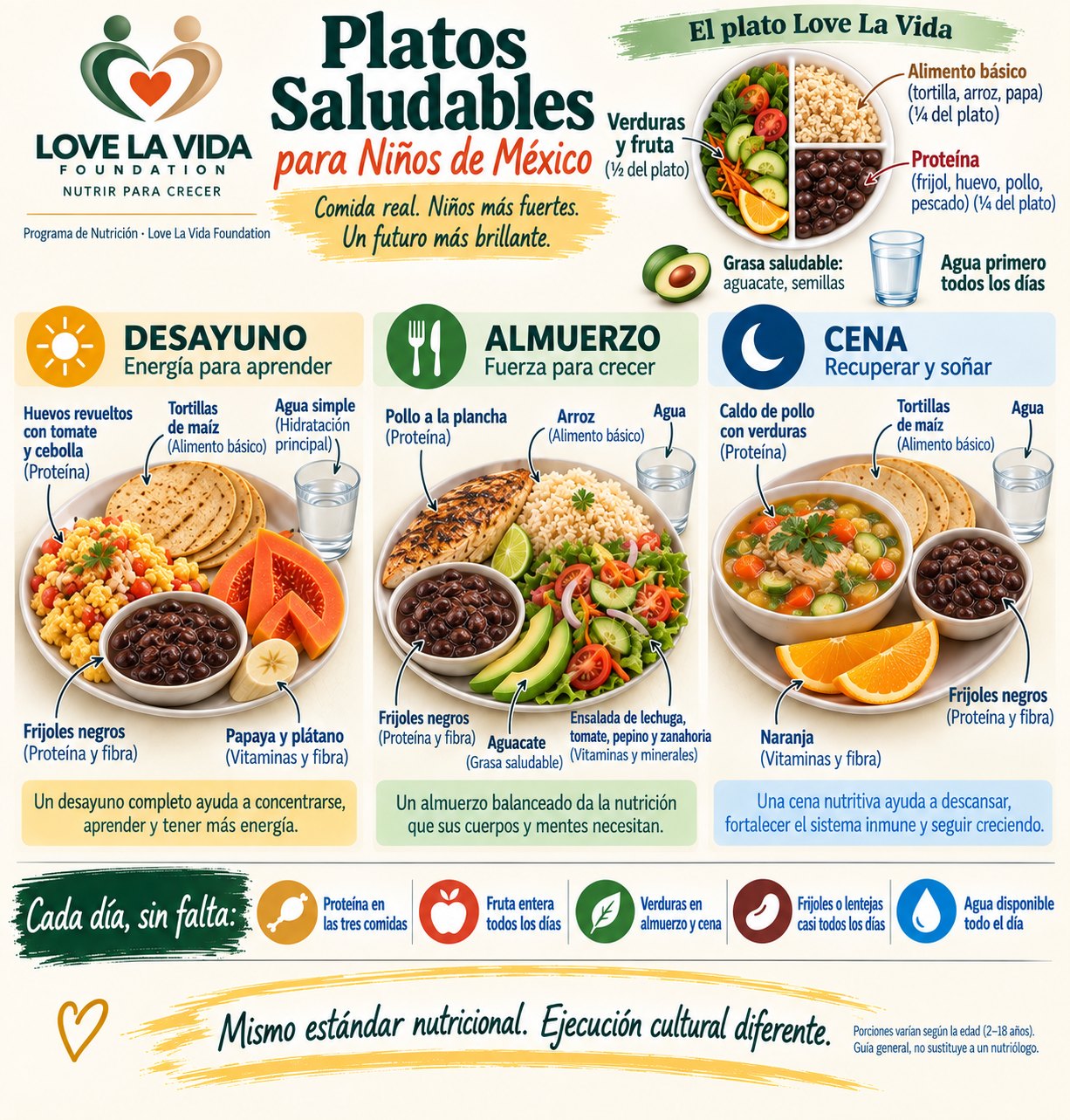
Mexico
Healthy Plates for Children in MexicoPlatos Saludables para Niños de México — the poster itself is in Spanish
Three meals built from ordinary Mexican food — nothing imported, nothing a market in Chiapas or Guanajuato would not have. This is the destination, not the starting line. Read the section below before you judge your own kitchen against it.
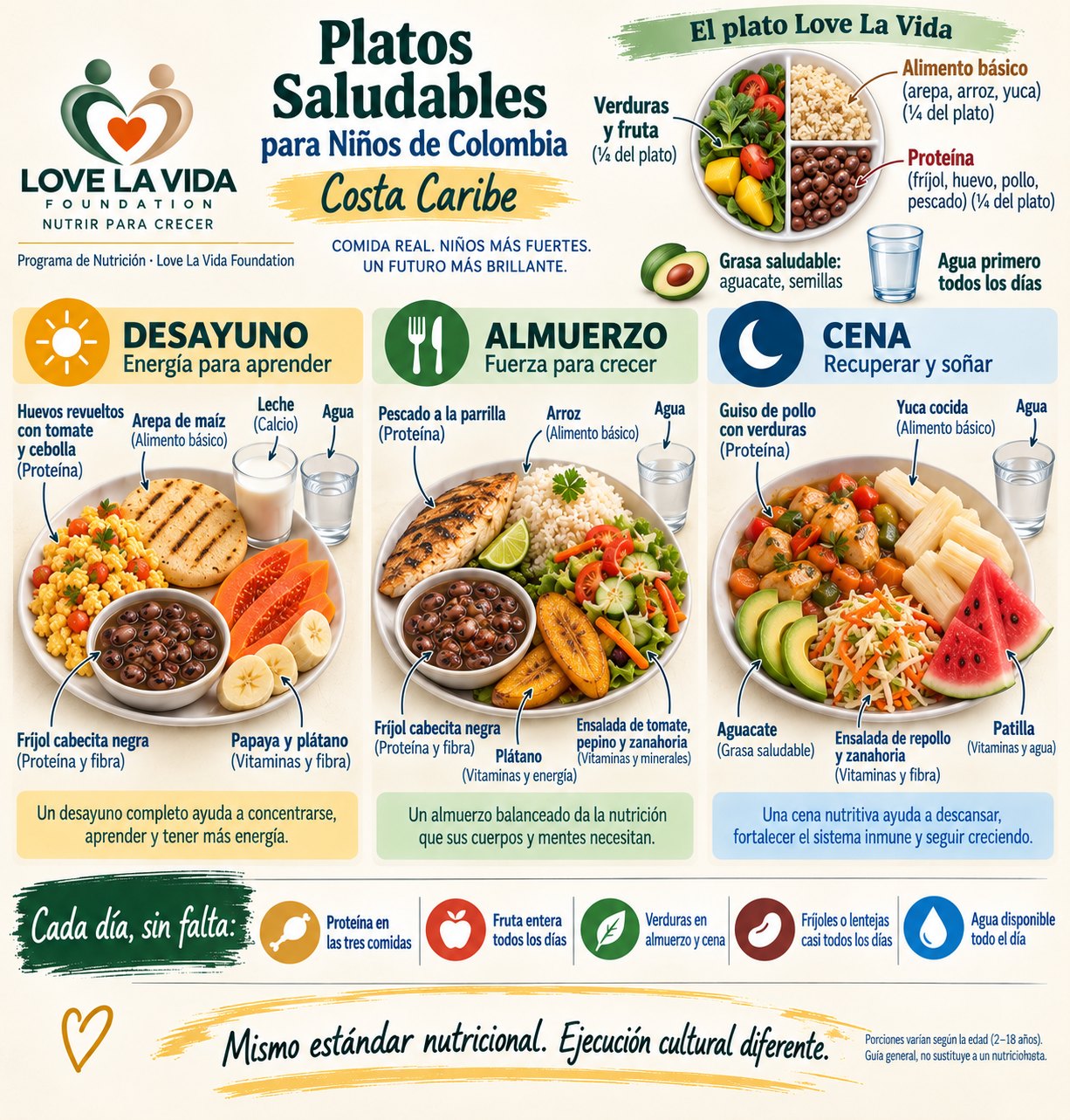
Colombia
Healthy Plates for Children in ColombiaPlatos Saludables para Niños de Colombia — the poster itself is in Spanish
The same three meals, rebuilt from the coast. Not a translation of the Mexican poster — a different kitchen, with arepa where the tortilla was and yuca where the rice was.
Printable tools
Three sheets that do the work a poster cannot
A poster shows what good looks like. These are the working documents that get it done — designed to be printed in black and white on ordinary paper, written on in pen, and replaced when they wear out.
One sheet a week
Seven-day menu
Breakfast, snack, lunch, snack, dinner, across seven days, with the plate rule at the top and a six-question check before you hang it. The single most common gap we see is a kitchen with no written menu — the cook decides each morning from whatever is there, and variety quietly disappears.
Download · PDF Spanish versionOne sheet per child
Growth record
Ten rows for date, age, weight, height and notes — twice a year for five years. How to measure so the numbers mean something, and the five signs that say take this child to the health post. It diagnoses nothing. It tells you when to ask someone who can.
Download · PDF Spanish versionOne sheet per young person
Leaving-care checklist
Identity, health, education, work, money, housing and people — what a young person needs in hand before they turn eighteen, with space to record where each original is kept. Opened at sixteen, not at eighteen. Replacing a lost document takes months, and nobody has months.
Download · PDF Spanish versionSpanish · 32 pages · Directors & teams · Un año para crecer
A Year to Grow
The clock the other twenty documents run on. Twelve months, fifty-two weeks, one capability at a time — with the month’s question, the age adaptation, the family activity and a single measure.
The twelve months map almost one to one onto the twelve capability domains, so this is not a thirteenth system competing with the rest. It says plainly which domain comes up short — Time — and what to do about it instead of adding a thirteenth month.
Its most useful page is the one that gets you from a need to a document: twenty needs, twenty documents, nothing that doesn’t exist. Plus twelve fifteen-minute staff trainings, each one a single question.
Download · PDFFree to print, copy, translate and adapt. Put your own home’s name on them if you want. The leaving-care checklist is a tracking tool, not a legal source — confirm every requirement with your local authority before acting on it, because the rules change and they differ by country.
Two more things, also free
If a PDF is not what you actually need
Printed and mailed
We will send you a printed set, free
Not every home has a working color printer, and toner costs more than most kitchens can spare. Tell us where to send them and a printed set goes in the post at no cost — with your home’s name on them if you want it there.
Request a printed setFive minutes, private
How is the food in your home?
Fifteen questions you answer yourself, with an immediate result and three concrete things to try this week — chosen from your answers, cheapest first. No sign-up, and we do not know you took it unless you tell us.
Take the assessment →The honest part
The distance between that poster and a real kitchen
In homes we have visited, a whole day of food has looked like this: a small bread roll with milk in the morning. Rice and beans at midday. Horchata and rice at night. That is the day.
Put that beside the poster above and the poster starts to read as a rebuke. It is not meant to be one, and no director chose that menu. A budget chose it. The poster is where a kitchen is going, not the line it is failing to meet.
So here is what we would actually say to a home feeding children that way, and none of it costs much:
- 1
The midday meal is already the best one. Rice and beans together make a complete protein — each one supplies what the other is missing. That is not a consolation prize. It is genuinely good food, and it is already on the table.
- 2
Breakfast is where one peso buys the most. An egg is among the cheapest protein there is. One egg added to the bread and milk changes a morning more than anything else on the poster above.
- 3
Dinner is usually the weakest meal and the cheapest to fix. Horchata is rice and sugar; served with rice, the evening is one food twice. The beans are already in the kitchen for lunch. Moving a portion of them to the evening costs nothing at all.
- 4
A squeeze of lime on the beans. The iron in beans is hard for a body to absorb on its own, and vitamin C changes that. A lime costs almost nothing and does real work.
- 5
Whatever vegetable is cheapest that week. Not the one on the poster — the one the market is selling cheap. Color on the plate is the goal; which color matters far less.
Being built now
El primer paso — the poster for a kitchen that is nowhere near the other two.
The same three meals, but starting from bread and milk, rice and beans, and building one cheap change at a time. It is the version most homes need first, and we should have made it first.
If you run a home, tell us what belongs on it. You know your budget and your market better than we ever will.
Why it is free
There is no form in front of this, and there is not going to be
The standard move is to put an email box in front of a download. We are not going to do that with this one.
A home feeding thirty children on a budget that does not stretch should not have to trade anything — not an address, not a conversation, not a meeting — for a picture of what a balanced day looks like. Dignity rather than charity applies to information too.
It is also the honest answer to a question we get asked early: what can you actually offer a home you have never met? This. Today. Whether or not anything else ever comes of it.
What we do not do
We do not know that you took it, and we would like to keep it that way.
No email box, no tracking on the download, no follow-up. If you want to hear from us, there is a form further down this site and you can decide that on your own terms.
Use it however you want. Print it, copy it, translate it into a local language, put your own home’s name on it, hand it to the home down the road. We are not precious about it. It exists to be on a wall.
How to use it
Made for a kitchen, not a report
- 1
Print it at letter size, portrait. The PDF is already set up for that. It reads clearly from across a room, which is the point.
- 2
Laminate it if you can, or slide it into a plastic sleeve. It is going somewhere with steam and hands.
- 3
Put it where food is prepared, not in the office. The person who needs it is the one cooking, and often that is a rotating group of people rather than one cook.
- 4
It is in Spanish because the people cooking read Spanish. The English on this page is for donors. The poster is for the kitchen.
- 5
Treat it as a shape, not a recipe. If the market had no papaya this week, the shape still holds — a protein, a grain, something from the ground, something that grew on a tree.
Coming
What we are building next
Everything here will be free on the same terms. We are building it in the order homes tell us they need it.
- A version for the youngest children — portions and textures for two to five, which is a different poster and not a smaller one.
- Shopping the same plates on a smaller budget — what to buy first when the money runs out before the month does.
- A growth and wellbeing check a home can run itself, twice a year, without a clinic.
- The same three meals as a weekly menu, so a kitchen can plan rather than decide each morning.
If you run a home and something else would be more useful than any of that, tell us. We would rather build the thing you actually need. Here is how to reach us →
These posters show general examples of balanced meals using foods common in each country. They are not medical or dietary advice, and they are not a substitute for a nutritionist or a doctor. A child with a specific medical or nutritional need should be seen by a professional.